Understanding GaN RF Power Transistor Technology
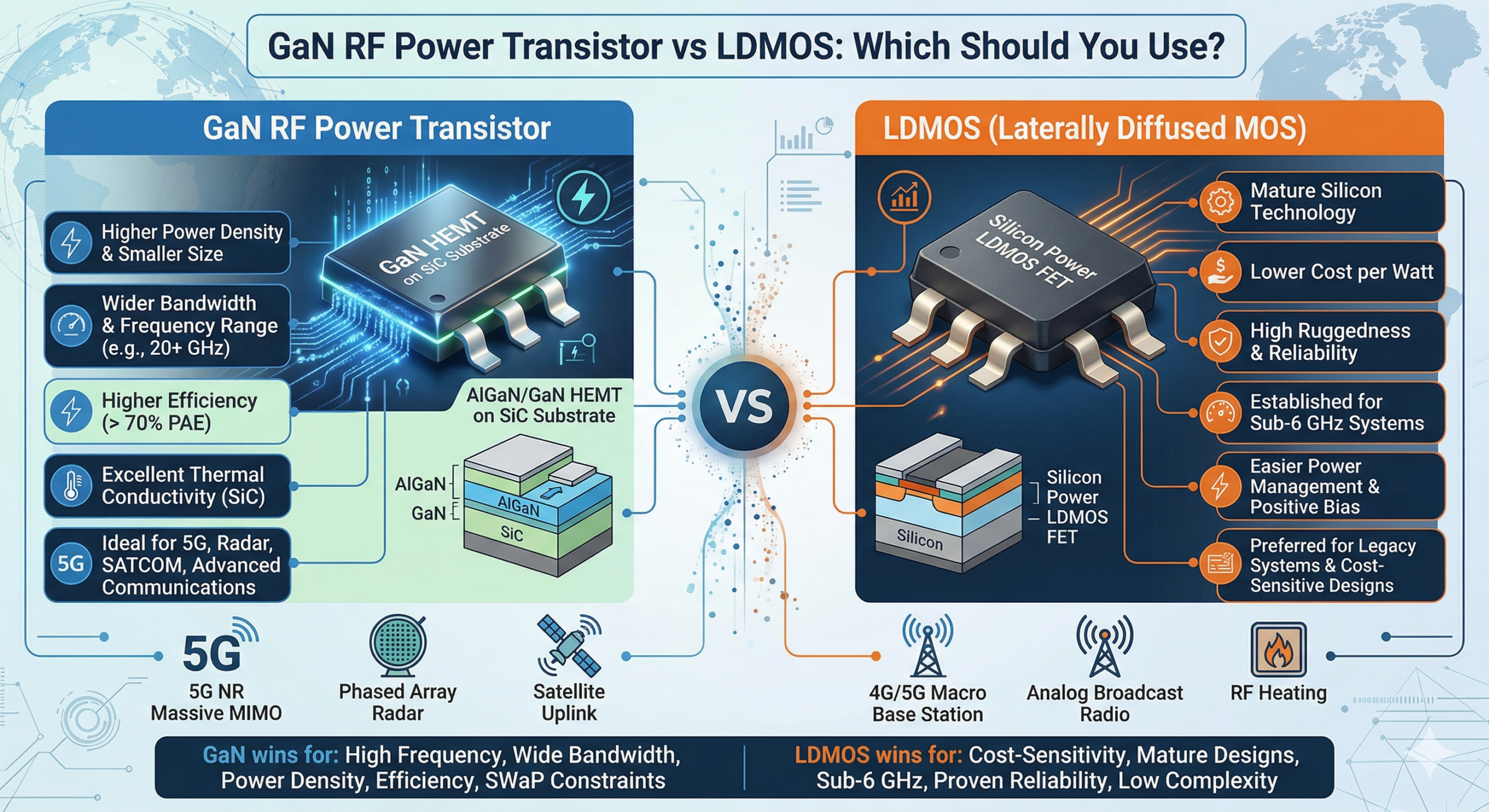
A GaN RF power transistor is built using gallium nitride, a wide bandgap semiconductor material. This allows the device to operate at higher voltages, higher frequencies, and higher power densities compared to traditional silicon-based technologies.
Because of its material properties, GaN technology offers:
- Higher efficiency at high frequencies
- Smaller device size for the same output power
- Improved thermal performance
- Strong performance in compact amplifier designs
GaN devices are commonly used in applications such as radar systems, satellite communications, wireless infrastructure, and defense electronics. They are especially useful when space is limited or when efficiency and heat management are critical design considerations.
What Is LDMOS and Where Is It Used?
LDMOS (Laterally Diffused Metal Oxide Semiconductor) is a silicon-based RF transistor technology that has been widely used for decades. It remains a dependable choice for many RF power amplifier designs.
LDMOS devices are typically selected for:
- Lower frequency RF applications
- Cost-sensitive designs
- Established amplifier platforms
- Broadcast and base station systems
LDMOS technology is mature, well understood, and broadly available. For many applications operating below certain frequency thresholds, it continues to perform reliably and economically.
Key Differences Between GaN and LDMOS
While both technologies serve RF power applications, the differences become clear when comparing electrical and physical characteristics.
Frequency Performance
A GaN RF power transistor performs well at higher frequencies due to its material properties and electron mobility. LDMOS devices are generally more common in lower frequency ranges.
If your system operates in higher GHz ranges, GaN may provide better efficiency and output stability.
Power Density
GaN devices offer higher power density. This means designers can achieve greater output power in a smaller footprint. For compact systems or weight-sensitive applications, this can simplify layout and reduce component count.
LDMOS devices typically require larger die sizes to achieve comparable power levels.
Efficiency and Thermal Management
Higher efficiency reduces wasted energy and heat. GaN devices tend to generate less heat for the same output power, which can reduce cooling requirements.
LDMOS remains efficient within its operating range but may require more thermal management in higher power designs.
Cost Considerations
LDMOS devices are often more cost-effective for established, lower-frequency systems. GaN technology may carry a higher initial component cost, but the system-level savings in efficiency and size can offset that in certain designs.
When Should You Choose a GaN RF Power Transistor?
A GaN RF power transistor is often the preferred choice when:
- Operating at higher frequencies
- Space and weight are limited
- Efficiency improvements are required
- High power output is needed in a compact design
It is particularly useful in aerospace, defense, satellite, and next-generation wireless infrastructure where performance margins matter.
However, device selection should always consider availability and lifecycle planning. Some high-performance components may have long lead times or become difficult to source as product lines change.
When LDMOS May Still Be the Right Option
LDMOS remains suitable for:
- Lower frequency RF systems
- Cost-controlled projects
- Legacy system support
- Applications where redesign is not practical
For companies maintaining established platforms, replacing LDMOS with GaN may not always justify the redesign effort.
Sourcing Considerations for RF Power Devices
Performance is only one part of the decision. Supply chain stability is equally important. Many RF power components, especially specialized or high-frequency devices, can become long lead-time or end-of-life (EOL) parts.
Working with an experienced RF component supplier helps reduce risk when:
- A GaN RF power transistor becomes difficult to source
- A specific LDMOS part is discontinued
- Authenticity verification is required
- Long lead times impact production schedules
Quality assurance and counterfeit mitigation programs are especially important in defense, aerospace, and industrial applications where reliability is critical.
Making the Right Choice for Your RF Application
There is no single answer for every design. A GaN RF power transistor offers strong advantages in high-frequency, high-efficiency, and compact applications. LDMOS continues to serve reliably in established, lower-frequency systems.
By carefully reviewing frequency range, power requirements, thermal constraints, and sourcing considerations, engineers and buyers can select the technology that supports both performance goals and long-term supply stability.
If you are evaluating a GaN RF power transistor or replacing an existing LDMOS device, understanding both the technical and supply-side factors will help you move forward with confidence.